
The moment you sit down across from a hiring manager, the air shifts. The pleasantries end, notebooks are opened, and the inevitable question hangs in the room: “So, tell me about yourself.”
How you navigate the next ninety seconds dictates the trajectory of the entire conversation. According to recent workforce research, a candidate’s response to this single question determines 44% of their overall interview success.
It is not merely an icebreaker; it is a high-stakes test of your self-awareness, communication pacing, and ability to filter a lifetime of experience into a highly relevant professional narrative.
Many candidates default to a chronological recitation of their resume. They start with their university degree, march through their early internships, and painstakingly list the duties of every role they have held since.
This approach is a critical misstep. Interviewers have already read your resume. When they ask this question, they are testing your ability to synthesize information and connect your background directly to their immediate business needs.
The Psychological and Algorithmic Stakes
The significance of this inquiry is derived from the fundamental principles of human psychology and, to a greater extent, machine learning algorithms. Within 100 milliseconds of visual contact, individuals develop perceptions of trustworthiness and competence.
The primacy effect, a cognitive reality, posits that the initial information an interviewer processes about you has approximately three times the impact of the subsequent information.
The interviewer will subconsciously seek out other symptoms of disorganization throughout the meeting if you open with a rambling, unfocused history, as confirmation bias will be an issue.
Additionally, the recruiting environment has undergone a significant transformation. Currently, 87% of organizations employ artificial intelligence to evaluate prospective employees.
AI platforms such as HireVue analyze vocal patterns, keyword density, and facial expressions during asynchronous video interviews.
Structured responses with a clear logical flow and concrete, quantifiable examples are highly favored by these systems. Unstructured meandering is almost certain to result in rejection, regardless of whether you are conversing with a human executive or an algorithmic screener.
The Blueprint: The Present-Past-Future Framework
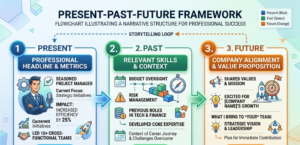
To move past the chronological resume dump, professionals must adopt a highly strategic narrative structure. The most effective framework relies on a “Present-Past-Future” sequence. This architecture satisfies the listener’s need for context while firmly pointing the conversation toward the value you bring to the specific role.
1. The Present: Your Professional Headline
You must anchor the listener immediately. Begin with who you are right now. This is not the time to talk about your childhood or your high school accomplishments. State your current title, your core area of expertise, and a specific, quantifiable achievement that proves your competence.
If you are a mid-level data analyst, you might say: “I’m currently a Senior Data Analyst at a fintech startup, where I specialize in transforming raw user data into actionable business insights. In my most recent project, I developed a new dashboard that helped the marketing team identify and reduce customer churn by 15% in just one quarter”.
This opening immediately establishes authority. It gives the interviewer a tangible metric and clearly defines your current market value.
2. The Past: Connecting the Relevant Dots
After establishing your current standing, reach back into your history—but only pull forward the experiences that directly built the skills required for the role you are discussing. You are curating your history, not recounting it.
A transition might sound like this: “Before this, I spent three years at a larger e-commerce company, honing my skills in SQL and Python for large-scale data manipulation. That environment taught me how to collaborate with non-technical stakeholders to ensure my analysis drove real business decisions, rather than just sitting in a report”.
Notice the strategic trade-off here. The candidate completely bypassed their entry-level jobs and internships, sacrificing historical completeness in favor of extreme relevance.
3. The Future: Making It About Them
The final pivot is where most candidates fail. You must connect your curated history directly to the company’s current problems or objectives. This demonstrates that you have researched their mission statement and corporate values and understand the immediate deliverables of the role.
“I’ve been following your recent launch of predictive analytics tools, which is why I was so excited to see this role open up. I believe my experience in reducing customer churn and building cross-functional data tools can directly help your team enhance customer personalization and achieve its growth targets for the coming year”.

Delivery Mechanics: The Unspoken Variables
A perfectly scripted response will still fail if the delivery falls flat. Human communication relies heavily on non-tangible cues; famously, early studies suggested that non-verbal elements dictate a massive percentage of our first impressions.
Pacing and Word Count The ideal response to “Tell me about yourself” sits in a strict temporal sweet spot: between 90 seconds and two minutes. Responses that drag past the 2.5-minute mark consistently result in a sharp drop in interviewer engagement. Conversely, finishing in under 30 seconds can signal a lack of preparation or a lack of depth.
If you map this to the speed of professional speech, the optimal pace is 140 to 160 words per minute (WPM). Speaking too quickly muddies your message and broadcasts nervousness. You should prepare a narrative that is roughly 200 to 250 words total.
Video Interview Adjustments The explosion of remote hiring, growing 57% over five years, requires specific technical adjustments. During video interviews, candidates often look at the face of the interviewer on their screen. This drops your eyeline and breaks the illusion of eye contact. You must look directly into the camera lens.
Position your camera at true eye level, keeping your eyes about one-third of the way from the top of the frame, allowing for about 10% headroom.
Standing up during video interviews naturally improves your breathing mechanics and vocal energy projection.
Adapting to Industry Nuances
Your baseline narrative must shift depending on the sector you are targeting. Hiring managers in different industries listen for fundamentally different cultural and technical markers.
- FAANG and Large Tech: Focus heavily on technical excellence, scale, and system architecture. Metrics should highlight latency reduction, millions of users impacted, and system uptime.
- Startups: Emphasize agility, resourcefulness, and business impact under constraints. A startup founder wants to hear that you built demand generation engines from scratch or wore multiple hats during a critical product launch.
- Finance and Private Equity: Structure is everything. Rely on terminology like DCF, LBO, and portfolio performance. You must quantify deal values, cost savings, and returns.
- Consulting (McKinsey, BCG, Bain): These firms look for highly structured problem-solving and change management capabilities. They want to hear about stakeholder management and measurable client impact.
Comparison: The Resume Dump vs. The Strategic Pitch
To clearly illustrate the difference between a failing answer and a winning answer, examine the following comparison for a mid-level marketing professional.
| Element | The “Resume Dump” (Failing) | The Strategic Pitch (Winning) |
|---|---|---|
| Opening | “I graduated from State University in 2018 with a marketing degree…” | “I am a digital marketing manager specializing in B2B lead generation…” |
| Middle | “…then I got an internship at an agency, then worked at Company X doing social media…” | “…over the past five years, I grew the pipeline by 340% by focusing on data-driven campaigns…” |
| Closing | “…and now I am looking for a new opportunity to grow.” | “…and I am excited to bring my expertise in customer acquisition to your upcoming SaaS launch.” |
| Focus | Me-centric, chronological, tedious. | Them-centric, achievement-based, concise. |
Real-World Case Study: The Career Changer
Career changers face a unique hurdle. Without a linear path, they risk sounding unfocused or inexperienced. The goal here is to bridge the gap using highly transferable skills.
Consider a professional moving from Graphic Design to User Experience (UX) Design. If they list their design jobs, the hiring manager may view them as purely visual, lacking the analytical rigor required for UX.
A highly effective “Tell me about yourself” for this transition focuses heavily on the why.
“For the past five years, I’ve been a Senior Graphic Designer creating brand identities for tech clients. While I love visual storytelling, I found myself increasingly drawn to the ‘why’ behind user decisions, which led me to complete a comprehensive UX certification.
My background in graphic design taught me how to take complex client feedback and translate it into functional products—a skill I’ve found directly transferable to interpreting user research.
I deeply admire your team’s commitment to accessibility, and I’m eager to bring my visual design expertise and UX research skills to help simplify your user onboarding flow”.
This answer acknowledges the non-linear path, extracts the transferable skill (translating complex feedback), and applies it directly to the prospective employer’s onboarding challenge.
Common Mistakes to Avoid
Even seasoned professionals sabotage their interviews by falling into easily avoidable traps.
The Personal Overshare Rapport is valuable, but 47% of recruiters cite overly personal responses as a primary reason for candidate rejection. Unless specifically asked, leave out details regarding your marital status, children, political views, and religious affiliations. Your interviewer is assessing your professional capacity, not your weekend hobbies.
The “Refer to My Resume” Defense. Never begin your answer by saying, “Well, everything you need to know is on my resume”. This comes across as combative, lazy, and fundamentally misunderstands the purpose of the question. The interviewer is looking for your verbal synthesis, not a reading test.
The Rambling Trap Nerves often manifest as endless talking. Rambling undermines your perceived confidence and buries your core value proposition under a mountain of irrelevant details. If you realize you have been talking for too long, stop. A graceful recovery looks like taking a breath and saying, “Wow, that was a lot. I hope you can tell I’m really excited about this opportunity!”
Essential Pre-Interview Checklist
Before stepping into the room or logging onto the video call, verify you have completed the following steps:
- Deconstruct the Job Description: Identify the top 3-5 skills the employer needs.
- Draft the 3-Part Outline: Write distinct bullet points for your Present, Past, and Future.
- Time Your Delivery: Record yourself speaking. Ensure you fall strictly within the 90 to 120-second window.
- Check Your Metrics: Verify you have included at least one hard number, percentage, or specific timeframe.
- Test Your Equipment (Video Only): Confirm your camera is at eye level and that the lighting clearly illuminates your face without heavy shadows.
Final Thoughts on First Impressions
The prompt “Tell me about yourself” is the most predictable challenge in the contemporary recruiting process; it is the most frequently mishandled. You will immediately distinguish yourself from the majority of candidates by rejecting the inclination to recount your history and adopting the structured, focused Present-Past-Future framework.
Your objective is not to demonstrate that you have led a full and active existence. Your objective is to demonstrate that your unique trajectory is the precise solution to the employer’s current issues within the confines of approximately 150 carefully selected words.