You’re standing in a hardware store aisle or, more likely, scrolling through Amazon at midnight, trying to figure out which outside lighting won’t silently drain your wallet month after month.
Perhaps you’ve already purchased solar lights that ceased operating after a dreary week. Perhaps you’re paying a high electric bill every summer because your porch light runs all night. In any case, you are not seeking a general “both have pros and cons” response. Which option leads to more real-world savings?
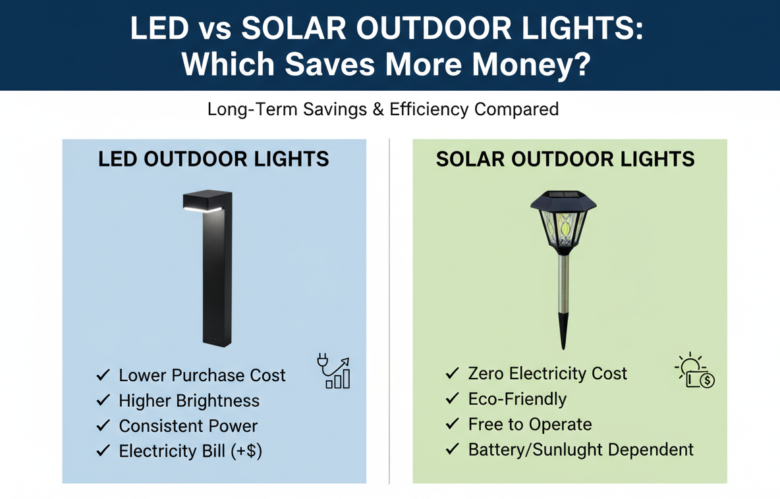
For most budget-conscious renters and homeowners, LED outdoor lights with a smart timer save more money in the long run due to continuous performance, but solar wins if you have a lot of sun and don’t want to deal with wiring or electricity costs.
The best option is determined by your climate, usage hours, and the length of your stay at the property.
Understanding What You’re Actually Paying For?
Before comparing, let’s get clear on what each technology involves because most people don’t realize they’re comparing two very different cost structures.
How LED Outdoor Lights Work?
LED (Light Emitting Diode) lights plug into your home’s electrical grid.
You pay:
- Upfront cost: $10–$60 per fixture
- Ongoing cost: Electricity — roughly $1.50–$4/month per bulb running 8 hours/night
- Lifespan: 15,000–50,000 hours (10–25 years with normal use)
- Maintenance: Near-zero, occasional bulb swap every several years
LEDs are incredibly efficient compared to older incandescent or halogen lights. A 10-watt LED replaces a 60-watt incandescent and produces the same brightness.
How Solar Outdoor Lights Work?
Solar lights collect energy during the day via a photovoltaic panel and store it in a rechargeable battery to power the light at night. You pay:
- Upfront cost: $15–$80+ per fixture (quality varies dramatically)
- Ongoing cost: $0 in electricity
- Lifespan: 2–5 years for budget models; 5–10 years for premium ones
- Battery replacement: Every 2–3 years, roughly $5–$15 per unit
- Maintenance: Panel cleaning, battery swaps, repositioning for sunlight
The “free electricity” selling point is real, but the battery degradation and lower reliability in cloudy climates are costs most buyers overlook.
LED vs Solar Outdoor Lights: The True Long-Term Cost Breakdown
Let’s run real numbers over 5 years for a typical scenario: one outdoor light running 8 hours per night.
5-Year Cost Comparison Table
| Factor | LED Outdoor Light | Solar Outdoor Light |
|---|---|---|
| Upfront cost | $25 (fixture + bulb) | $35 (mid-range solar) |
| Electricity cost (5 yrs) | ~$36–$72 | $0 |
| Battery replacement | $0 | $10–$20 |
| Bulb/part replacements | $5–$10 | $5–$15 |
| Total 5-Year Cost | $66–$107 | $45–$70 |
| Reliability | Very high | Moderate (weather-dependent) |
| Brightness consistency | Consistent | Varies by season/weather |
| Best for | All climates, high-use areas | Sunny climates, low-use areas |
Key takeaway: Solar wins on paper for 5-year cost but only if it actually works reliably. In cloudy regions or during winter, solar lights often underperform, which changes the value equation significantly.
Brightness and Performance: Where LED Has a Real Edge?
This is the section solar light marketing doesn’t want you to read carefully.
Solar lights dim as the battery drains. By 3 AM, a solar light running since sunset is often operating at 30–50% of its rated brightness. LED lights stay at full brightness all night, every night.
For security lighting, pathway safety, or areas where you actually need to see clearly, this matters enormously.
Lumens Comparison by Use Case
- Pathway/accent lighting: Solar is sufficient (200–400 lumens).
- Porch/entryway: LED preferred (600–1000 lumens needed reliably).
- Security/flood lighting: LED required (1500+ lumens, consistent).
- Decorative string lights: Solar works well (low lumen needs).
Lifespan Reality Check: Which Lasts Longer?
The lifespan gap between LED and solar is one of the most underappreciated cost factors.
LED lights: A quality LED bulb is rated for 25,000–50,000 hours. Even running 8 hours a night, that’s 8–17 years before replacement.
Solar lights: The panel itself can last 10+ years, but the rechargeable battery is the weak link. Most budget solar light batteries degrade significantly within 18–24 months. After 3 years, many budget solar lights barely hold a charge through the night.
This means you may replace a cheap solar light 2–3 times in the same period that a single LED fixture runs without issue.
Bottom line: LED wins decisively on lifespan and total replacement cost.
5 Common Mistakes People Make When Choosing Between LED and Solar
1. Buying the Cheapest Solar Lights Available
Budget solar lights under $10 often use low-capacity batteries (600–800mAh) that die within a year. The money-saving illusion disappears fast. Fix: Spend at least $25–$35 per solar fixture for a battery rated at 1200–2000mAh.
2. Installing Solar Lights in Shaded Areas
A solar light in partial shade charges at a fraction of its rated capacity. Many people place solar path lights under trees or near fences — exactly where sunlight is blocked. Fix: Map your yard’s sun exposure before buying. Solar needs 6–8 hours of direct sun daily.
3. Ignoring Electricity Usage When Calculating LED Costs
LEDs are cheap to run — but leaving outdoor lights on 24/7 instead of 8 hours triples your cost. Fix: Use a smart plug or timer. A $12 outlet timer pays for itself in weeks.
4. Assuming Solar Works the Same Year-Round
In winter, days are shorter, the sun angle is lower, and temperatures affect battery efficiency. A solar light performing well in July may barely function in December. Fix: If you live above 40° latitude or in a cloudy climate, LED is almost always more reliable.
5. Forgetting to Factor in Maintenance Time
Solar lights need panel cleaning, repositioning, and battery replacement. For renters or people without outdoor maintenance routines, this time cost adds up. Fix: Be honest about your willingness to maintain them. If the answer is “low,” go LED.
Pro Tips and Expert Insights You Won’t Find in Basic Reviews
Tip 1: Use LEDs for security, solar for ambiance. A hybrid approach works brilliantly. Install LED flood lights with a motion sensor at entryways (reliability matters), and use solar string lights or path lights for decorative areas (reliability less critical).
Tip 2: Motion-sensor LEDs dramatically cut electricity costs. A motion-activated LED porch light uses electricity only when triggered, often reducing energy use by 70–80% compared to a light that runs all night.
Tip 3: Solar light battery replacement is DIY-easy. Most solar lights use standard NiMH AA or AAA batteries. Replacing them costs $3–$8 and extends the light’s life by 2–3 years. Most people throw away the entire fixture instead.
Tip 4: Check the IP rating before buying either type. For outdoor use, look for IP65 or higher. This means dust-tight and protected against rain jets. Cheaper lights (solar or LED) often have IP44 ratings that fail within a couple of rainy seasons.
Tip 5: Calculate your local electricity rate first. If you live in a state with high electricity costs (California, Hawaii, New York — $0.20–$0.40/kWh), solar’s electricity savings are worth more. In low-rate states ($0.09–$0.12/kWh), the savings gap narrows significantly.
Real-Life Scenario: How Maya Solved Her Outdoor Lighting Problem for Under $80?
Maya rents a ground-floor apartment in Phoenix, Arizona. She wanted to light a small patio and the pathway to her parking spot with a total of four lights.
Her situation:
- Renter (can’t hardwire anything).
- Phoenix gets 300+ sunny days per year.
- Pathway needed reliable nighttime lighting; patio was decorative.
What she did:
- Bought two quality solar path lights ($32 total) for the walkway, rated IP65, 1800mAh batteries.
- Bought solar string lights ($18) for patio ambiance.
- Used one existing porch outlet for a motion-sensor LED plug light ($14) at the parking spot.
Total spend: $64.
Monthly electricity cost: ~$0.60 (motion LED only runs 20–30 min/night).
18-month result: Zero replacements, consistent performance, and the electricity bill impact is negligible.
Maya’s success came from matching the technology to the use case solar, where reliability needs were flexible, and LED, where they were non-negotiable.
Frequently Asked Questions
Do solar lights work in winter?
Yes, but less effectively. Cold temperatures actually improve battery efficiency slightly, but shorter days mean less charging time. If your winter has fewer than 5 hours of usable sunlight, expect 50–70% performance from most solar lights.
Can I replace LED outdoor bulbs with solar-compatible ones?
Not directly — they use different systems. LED fixtures connect to grid power; solar fixtures have integrated panels and batteries. You’d need to replace the fixture entirely, not just the bulb.
Are solar lights worth it for renters?
Often yes — they require no wiring, no landlord permission, and move with you. The tradeoff is reliability, so choose solar for decorative/low-stakes areas and plug-in LEDs for anything you actually depend on.
How many lumens do I need for outdoor path lighting?
100–200 lumens is sufficient for pathway marking. For functional walking safety, aim for 300–500 lumens. Security and flood lighting needs 1000–2000+ lumens.
What’s the ROI timeline for LED vs solar?
For LED: payback vs. incandescent is typically 6–18 months. For solar: payback vs. LED depends on electricity cost but ranges from 2–4 years, assuming reliable performance.
Are there solar lights bright enough for security use?
A few premium solar security lights (Baxia, Aootek, Ring Solar) hit 1500–2500 lumens with motion activation. They’re viable for security, but performance in cloudy conditions is still inconsistent. For 100% reliable security lighting, hardwired LED remains the standard.
Conclusion: LED vs Solar Outdoor Lights
There’s no single winner in the LED vs solar outdoor lights debate — but there is a smarter way to choose.
Choose LED if:
- You need consistent, high-brightness lighting.
- You live in a cloudy or cold climate.
- You want the lowest maintenance possible.
- Security or safety is the primary purpose.
Choose solar if:
- You get 6+ hours of direct sun daily.
- You want zero electricity costs and no wiring.
- Lighting is decorative or low-stakes.
- You’re renting and need a portable solution.
The smartest approach: Combine both. Use LED with a motion sensor or smart timer for critical areas, and solar for everything decorative. You’ll get the reliability of grid power where it counts and zero electricity costs where flexibility allows.
Don’t let the upfront price tag fool you in either direction. Run the real 5-year numbers for your climate and usage pattern; that’s where the true savings live.