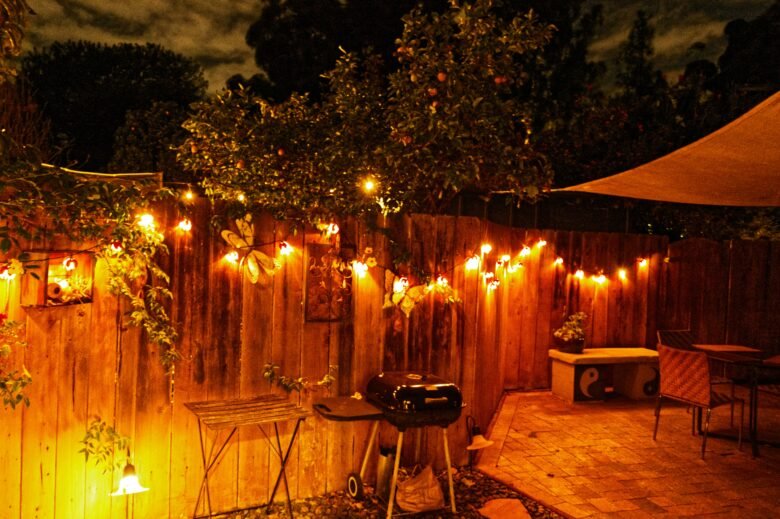
You really took the effort to decorate your apartment. The color scheme finally makes sense, the plants are doing well, and the furniture is just right. But when the sun goes down, something still feels wrong. Your outside lights are probably making things worse for you.
Not only does bad lighting make a room darker, but it also makes it look less expensive. It makes things look flat, takes away the atmosphere, and makes even pricey decorations look like they came from a gas station gift shop. The part that makes me mad? You don’t need permission from the landlord, and it doesn’t cost much to remedy most of these issues.
What Makes Outdoor Apartment Lighting Look Cheap?
The most common culprits are wrong color temperature (too cool or too warm), poor fixture placement, mismatched styles, over-lighting with no layering, and clutter from too many cheap string lights. Fix these five areas, and your balcony or entryway will look instantly more intentional and upscale.
Mistake #1: Using the Wrong Color Temperature
This is the single biggest lighting error, and almost nobody talks about it specifically enough.
Color temperature is measured in Kelvins (K).
Here’s what you need to know:
2700K–3000K = Warm white. Think candlelight, cozy, inviting. – Best for balconies and entryways.
4000K–5000K = Cool white/daylight. Clinical, harsh, office-like. – Wrong for outdoor living spaces.
6500K = Stark blue-white. Looks like a parking garage. Never.
Why renters get this wrong: The packaging at hardware stores says “bright white” or “natural daylight,” and that sounds appealing. It isn’t. Cool-toned light flattens textures, makes skin look drained, and signals “utility space” rather than “curated living.”
The fix: Replace any bulbs above 3200K in your outdoor fixtures with 2700K warm whites. Solar lights and string lights often come pre-set at bad temperatures — check the label before buying.
Mistake #2: Placing All Your Light at One Level
If every light source sits at the same height, whether that’s all overhead, all at table level, or all on the railing, your space will look flat and staged, not lived-in and layered.
Layered lighting means you have:
- Ambient light (overall illumination, overhead or string lights)
- Task light (a functional small lamp near seating or a reading nook)
- Accent light (decorative uplighting a plant, highlighting a wall texture)
Most apartment balconies rely only on the one overhead fixture the landlord installed. That single point of harsh light casts unflattering shadows and turns your carefully arranged outdoor seating into something that looks like a waiting room.
The fix: Add a battery-powered or solar lantern at floor level near seating. Put a string of warm Edison bulbs at mid-height along a railing or fence. Use a small clip-on spotlight to graze a textured wall or a tall plant.
Mistake #3: Over-Lighting the Space (Yes, It’s a Thing)
More light does not equal better lighting. This is one of the most counterintuitive outdoor lighting mistakes renters make, especially those who discover solar stake lights on sale and buy twelve of them.
Over-lit spaces feel anxious and chaotic. Good lighting is about contrast and intention, not maximum visibility.
Signs you’ve over-lit your balcony or patio:
- Every corner is equally bright with no visual hierarchy.
- More than three separate light sources are competing for attention.
- The space looks “activated” even when you don’t want it to.
- It looks like a used car lot at night.
The fix: Edit ruthlessly. Pick one primary ambient source and one or two accent sources. Turn off anything redundant. Darkness is not the enemy; flat, undifferentiated brightness is.
Mistake #4: Mismatching Fixture Styles
A sleek matte-black wall sconce paired with a rustic rope lantern, a modern solar path light, and a string of vintage Edison bulbs, all on one 6-foot balcony? That’s not “eclectic.” That’s visual noise.
Why this happens: Renters tend to buy lighting piecemeal, one item at a time, as they find deals or as existing lights burn out. There’s no cohesion because there was never a plan.
The fix: Pick one design language before you buy anything. Some coherent directions that work well for apartments:
| Style | Fixture Finish | Bulb Type | Vibe |
|---|---|---|---|
| Modern Minimalist | Matte black, brushed nickel | Globe G25, clear | Clean, architectural |
| Warm Industrial | Bronze, aged iron | Edison ST64 | Cozy, editorial |
| Coastal Relaxed | Woven rattan, white ceramic | Soft warm white | Breezy, curated |
| Japandi | Natural wood, stone | Warm diffused | Calm, intentional |
You don’t need to spend more. You need to spend consistently.
Mistake #5: Ignoring the Entryway Entirely
Your front door area is the first impression your apartment makes — on guests, on yourself when you come home, and on the overall feel of the space. Yet most renters treat it as an afterthought.
A dark, flat-lit, or completely unlit entryway communicates neglect. A well-lit one feels intentional and welcoming.
Common entryway lighting mistakes:
- Relying solely on the hallway’s overhead fluorescent light.
- No lighting on or near the door itself.
- Using a motion-sensor security light as the only fixture (functional, but cold and unfriendly).
The fix: Add a battery-operated wall sconce on either side of the door (command strips work on most surfaces and leave no damage). A small solar lantern on the floor beside the door adds warmth without any wiring. Cost: under $40 total.
Mistake #6: Using Cheap String Lights Wrong
String lights can look elevated. They can also look like a college dorm circa 2009. The difference is almost entirely in how they’re used.
What makes string lights look cheap:
- Hanging them in a loose drape with no structure.
- Using blue-white or multicolored bulbs.
- Overlapping multiple strands haphazardly.
- Buying the thinnest, cheapest wire with tiny bulbs spaced far apart.
What makes string lights look intentional:
- Running them along a clean line (railing edge, pergola beam, fence top).
- Using G40 or G50 globe bulbs on black wire, they read as “designed”.
- Keeping the strand to a single layer with consistent tension.
- Warm white only, always.
Pro tip: Outdoor café-style string lights with larger bulbs (the kind you see at rooftop restaurants) start at around $25–$35 for a 25-foot strand. They’re a significantly better investment than 3 cheap strands from a dollar store.
Mistake #7: Not Accounting for Daytime Appearance
Outdoor lighting doesn’t disappear when the sun is up — the fixtures are still there, and they’re part of your décor 24 hours a day.
Visible during the day:
- Ugly plastic solar stake lights.
- Tangled or sagging string light wires.
- Mismatched extension cords running visibly across surfaces.
- Faded or rusting fixtures.
The fix: Choose fixtures that look good unlit. Rattan lanterns, ceramic pots with built-in solar lights, and brushed metal wall sconces add to the daytime aesthetic, not subtract from it. Cord management clips ($6 at any hardware store) solve 80% of the “messy wire” problem instantly.
Pro Tips From People Who Actually Design Outdoor Spaces
1. Use dimmers wherever possible. Even battery-powered string lights often have a dimmer option. Being able to bring the light down 30–40% transforms a functional space into an intimate one.
2. Warm up solar lights with an amber cellophane filter. If you own solar lights stuck at a cool temperature, you can tape a small piece of amber gel film over the lens. It shifts the color noticeably warmer for about $0 in materials.
3. The “squint test.” Stand back and squint at your lit space at night. If you see one bright blob instead of distinct, layered pools of light, you have a single-source problem. You need more depth.
4. Reflect light off surfaces. A white or light-colored wall will amplify and diffuse a warm light source beautifully. Position an uplight or lantern near a light wall rather than against a dark fence.
5. Don’t light the space, light what’s in the space. Point a light at your plant, your textured throw pillow arrangement, your ceramic planter. Objects lit from below or beside look dramatically more interesting than objects lit from above.
Real-Life Scenario: How One Renter Fixed a $0 Problem?
Maya, a 28-year-old renter in a third-floor apartment, had a 60-square-foot balcony she avoided using at night. The landlord’s overhead fixture was a bare 5000K bulb that buzzed faintly and made everything look “like a hospital.”
She didn’t replace the fixture (no landlord permission needed since she didn’t touch the wiring). Instead:
- She screwed in a $4 warm 2700K Edison bulb to replace the existing one.
- She added a $28 G40 string light strand along the railing edge, clipped cleanly.
- She placed a $12 battery lantern at floor level near her two chairs.
Total cost: $44.
The result: She now uses the balcony almost every evening. The space photographs well, guests comment on it, and she feels like she’s in a boutique hotel rather than a utility porch. Nothing structurally changed. Only the lighting.
Frequently Asked Questions
Can I install outdoor lighting as a renter without damaging the walls?
Yes. Command strips, tension rods, hook-and-loop adhesive clips, and freestanding floor lanterns all work without drilling. Battery-operated and solar fixtures eliminate the need for outlet access.
What’s the best color temperature for a balcony?
2700K to 3000K is the sweet spot for outdoor residential spaces. It reads as warm and intentional without being yellow or orange. Avoid anything labeled “daylight” or “cool white” in outdoor living areas.
How many light sources do I need for a small balcony?
For a balcony under 80 square feet, two to three sources are ideal: one ambient (overhead or string), one floor-level accent, and optionally one task light near seating. More than three tends to over-light and flatten the space.
Are solar lights good enough quality for a curated look?
Modern solar lights have improved significantly. The key is buying from brands that specify warm-white output (2700K–3000K) and feature all-weather ratings. Avoid ultra-cheap sets — a single quality solar lantern beats four bad ones.
My landlord’s fixture is ugly. What can I do?
If it’s a standard socket, swap the bulb. If the fixture itself is an eyesore, hang a decorative pendant lantern on a separate hook nearby to draw the eye away, and use the original fixture only as a backup. You can also cover an ugly fixture shade with a clip-on fabric diffuser.
Conclusion
Outdoor lighting mistakes are among the easiest décor problems to fix — and among the most impactful. You don’t need to rewire anything, spend hundreds of dollars, or get your landlord involved. You need to get the color temperature right, layer your light sources at multiple heights, commit to one fixture style, and stop treating your entryway and balcony as afterthoughts.
The seven mistakes covered here, wrong color temperature, single-level placement, over-lighting, style mismatches, ignored entryways, misused string lights, and poor daytime fixture choices, are all correctable this week for under $50 in most cases.