You buy outdoor lights, put them up, and turn them on. Then either you can’t see anything because it’s so dark, or your neighbor calls to ask why your backyard looks like a stadium.
Does this sound familiar?
Almost everyone who buys outdoor lights for the first time has trouble picking the proper brightness. The problem isn’t that the information isn’t there; it’s that it’s hidden in jargon, standards, and advice that thinks you already know what a lumen is.
How Many Lumens Do You Actually Need Outside?
For most outdoor spaces, 40–100 lumens handles pathways and accent lighting, 100–300 lumens works for porch, step lighting, and 700–1300 lumens is right for security or floodlights.
The exact number depends on the purpose of the light, the size of the area, and whether you want ambiance or visibility.
What Is a Lumen? (And Why Watts Don’t Matter Anymore)
Before choosing brightness levels, you need to understand what you’re actually measuring.
A lumen (lm) measures the total amount of visible light produced by a source. Watts measure energy consumption — not brightness. With the rise of LED lighting, a 10-watt LED can produce the same lumens as a 60-watt incandescent bulb.
This matters because:
- Packages often still show watts prominently.
- Comparing LED vs. halogen by watts is meaningless.
- Lumens are the only reliable comparison across bulb types.
Quick rule of thumb: 1 watt of LED ≈ 75–100 lumens
How to Choose the Right Lumens for Outdoor Lighting: Zone by Zone
The biggest mistake people make is treating their entire outdoor space as one unit. Your front path, your patio, your driveway, and your security light all have different jobs. Each needs a different brightness level.
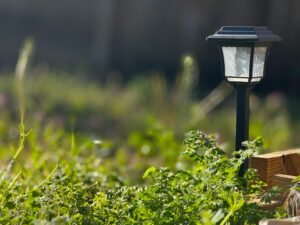
Zone 1: Pathway and Walkway Lighting
Recommended range: 40–100 lumens per fixture
Path lights are meant to guide, not illuminate. Their job is subtle — marking the edge of a walkway so guests don’t step into your flower beds at night.
Best practices:
- Space fixtures 6–8 feet apart for even coverage.
- Aim for a warm color temperature (2700K–3000K) for a welcoming look.
- Choose downward-facing fixtures to reduce glare.
Going above 100 lumens on a pathway makes the lights feel harsh and industrial. You want people to feel comfortable, not interrogated.
Zone 2: Step and Stair Lighting
Recommended range: 12–100 lumens per step light
Step lighting is a safety priority, but it doesn’t need to be blinding. The goal is edge definition; the viewer needs to clearly see where one step ends and the next begins.
- Built-in riser lights: 12–50 lumens is usually enough.
- Post-mounted step lights: 50–100 lumens.
- Always position lights to eliminate shadows on the tread surface, not just the riser.
You may also want to read: Outdoor Step Lighting Ideas That Are Both Safe and Stylish
Zone 3: Porch and Entryway Lighting
Recommended range: 400–800 lumens total for the entryway area
Your front porch is a functional and aesthetic zone. It needs enough light for people to find their keys, read house numbers, and feel secure — but it also sets the tone for your home’s curb appeal.
Consider:
- A single wall sconce at 400–500 lumens for a small porch.
- Two sconces flanking the door at 250–300 lumens each for balanced, shadow-free lighting.
- Add a downlight overhead fixture at 600–800 lumens for larger covered porches.
Tip: Layering two lower-lumen fixtures almost always looks better than one high-lumen fixture. It reduces harsh shadows and creates visual depth.
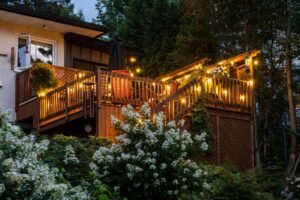
Zone 4: Patio and Deck Lighting
Recommended range: 600–1200 lumens total, distributed across multiple sources
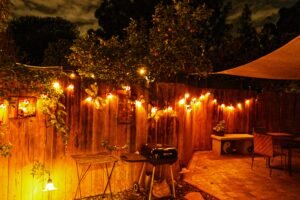
This zone is where ambiance matters most. Nobody wants to eat dinner under a floodlight. The goal is comfortable, usable light that doesn’t kill the mood.
Effective approaches:
- String lights: 200–400 lumens per strand (warm white, 2700K).
- Post cap lights: 100–200 lumens each.
- Recessed deck lights: 50–150 lumens each.
- Combine these layers rather than relying on a single bright source.
Think of this zone like indoor living room lighting — you wouldn’t use one harsh overhead bulb for everything. The same logic applies outside.
Zone 5: Driveway and Garage Lighting
Recommended range: 1000–2000 lumens
Driveways are both safety and convenience zones. You need enough light to see clearly when pulling in at night, identify faces, and discourage loitering.
- A pair of 500–800 lumen wall-mounted lights flanking the garage door works for most homes.
- For long driveways, add post lights every 30–40 feet at 100–200 lumens each.
- Opt for motion sensors to avoid leaving high-output lights on all night — this saves energy and reduces light pollution.
Zone 6: Security and Flood Lighting
Recommended range: 700–2000 lumens for security; 2000–4000+ for extensive commercial-style coverage
Security lighting has one job: to make the dark visible. This is where higher lumens are genuinely justified.
- Standard residential security light: 700–1300 lumens.
- Motion-activated floodlights: 1000–2000 lumens.
- Large property or commercial perimeter: 2000–4000+ lumens.
Important: Even for security, placement matters more than raw brightness. A 1000-lumen light aimed correctly beats a 2000-lumen light pointed at the sky.
5 Common Mistakes to Avoid
1. Buying the Brightest Fixture Available “Just to Be Safe.”
More lumens doesn’t mean more safety. Overlighting creates glare, which actually reduces visibility by creating harsh contrast between bright and dark areas. Your eyes struggle to adjust. Use the recommended ranges.
2. Ignoring Color Temperature
Lumens control brightness; Kelvin (K) controls the color tone. A 2700K warm white and a 5000K cool white at the same lumens feel completely different. Cool light feels clinical outside. Stick to 2700K–3000K for residential outdoor lighting unless you specifically want a modern/commercial feel.
3. Placing All Lights at Eye Level
Eye-level fixtures cause glare. Position pathway lights to shine downward, flood lights to aim at a surface, and accent lights to highlight objects, not eyes.
4. Forgetting About Light Pollution
If your outdoor lights shine upward or outward beyond your property, you’re wasting energy and contributing to light pollution. Use full-cutoff or downward-directed fixtures to keep light where it belongs.
5. Choosing Lumens Without Considering Fixture Spacing
A 200-lumen light covering 4 feet of path feels very different from the same fixture covering 12 feet. Always calculate spacing alongside lumens, not independently.
Pro Tips From Experienced Installers
The 10-foot rule: For general outdoor areas, aim for roughly 1 footcandle of light per square foot. One footcandle equals about 10.76 lumens per square meter — useful for back-of-napkin planning.
Test before committing: Before permanently wiring fixtures, use a portable LED lantern or temporary clip-on lights to test brightness in the actual location at night.
Consider dimmers: Many LED outdoor fixtures support dimmer switches. Installing one lets you run security lights at full brightness during high-risk hours and dial them back at 2 am when they don’t need to be blazing.
Think about seasons: Trees that block light in summer become bare in winter, dramatically changing how your lighting feels. Plan for the lowest-foliage scenario.
Smart lighting is worth it: Smart outdoor bulbs let you adjust lumens remotely. You can run your patio at 30% brightness during a dinner party and bump to 100% if you hear something in the yard.
Real-Life Scenario: Sarah’s Backyard Lighting Overhaul
Sarah bought a new home with a covered patio and a long garden path. She installed two 1500-lumen floodlights on the patio and a row of 200-lumen path lights along the walkway.
The result? Her patio felt like a parking garage, and the path lights were so bright they overwhelmed every other element in the garden.
Here’s what she changed:
- Replaced patio floods with four 250-lumen string lights (warm white, 2700K) and two 400-lumen wall sconces total of ~1800 lumens, but distributed and diffused
- Swapped path lights to 50-lumen downward-facing fixtures, spaced 6 feet apart
- Added two 1000-lumen motion-sensor floodlights at the back fence — dedicated security coverage, activated only when needed
Total cost of changes: approximately $120 in new fixtures. The difference was immediate — the patio became usable and inviting, the path was clearly visible without being harsh, and the security zone was genuinely better covered.
FAQs
Can outdoor lights be too bright?
Yes. Excessive brightness creates glare, disturbs neighbors, disrupts wildlife, and wastes electricity. More isn’t always better — the right lumens for the purpose is the goal.
What lumens do I need for outdoor security cameras to work well?
Most security cameras need a minimum of 1–2 footcandles of light (roughly 10–20 lux) for color recording. A 500–700 lumen light directed at the camera’s field of view is usually sufficient.
Are solar outdoor lights bright enough?
Budget solar path lights typically produce 10–30 lumens, fine for decoration, borderline for safety. Higher-end solar lights now reach 200–400 lumens, which is acceptable for patios and steps. For security lighting, wired or battery-powered is still more reliable.
How many lumens do I need for a small front yard?
A typical small front yard with a path and porch needs roughly 800–1500 total lumens distributed across multiple fixtures, not from a single source.
What’s the difference between lumens and lux?
Lumens measure total light output from a source. Lux measures light intensity at a specific surface (lumens per square meter). Lux is more useful for evaluating how well-lit a surface actually is after the light travels and spreads.
Should I choose warm or cool white for outdoor lights?
For residential outdoor lighting, warm white (2700K–3000K) is almost always preferred. It’s inviting, flattering to landscaping, and feels more natural at night. Reserve cool white (4000K–5000K) for utility areas like garages or workshops.
Conclusion
Choosing the right brightness for outdoor lighting isn’t about picking the highest number on the box. It’s about matching the light output to the purpose, size, and mood of each specific zone.
Here’s what to remember:
- Paths and steps: 40–100 lumens — subtle, guiding light
- Porches and patios: Layer multiple lower-lumen sources for ambiance
- Driveways and garages: 1000–2000 lumens for practical visibility
- Security lighting: 700–2000+ lumens with smart placement
Start with the zone-by-zone guide in this article, use the reference table as your cheat sheet, and remember: a well-placed 500-lumen fixture will always outperform a poorly positioned 2000-lumen one.