You go out onto your modest balcony at nightfall. It’s dark outside. Not inviting. You can hardly tell where the railing ends, and your potted plant begins. You want to enjoy your outdoor space—drinks in the evening, coffee in the morning, and reading late at night—but without the right illumination, it feels more like a storage closet than a safe place to be.
If you live in an apartment, you have a special problem. You can’t rewire the building. You can’t put in permanent fixtures without putting your security deposit at jeopardy. And your space is probably small, like a 4×8 balcony or a narrow patio that can only fit a bistro set.
such where do you put lights such that they really make a difference? How can you avoid making the frequent mistakes that leave half of your space in the dark or, even worse, blind your neighbors?
Where Should You Place Outdoor Lights in a Small Apartment?
For a small apartment balcony or patio, focus on three placement zones: the entry point (by the door for safety), the seating area (at knee or table height for ambiance), and the perimeter (along railings or planters to define boundaries).
Use layered lighting, task, accent, and ambient in tight clusters rather than one central fixture. Space lights 3 to 5 feet apart in small areas to avoid harsh shadows. Prioritize cordless, weather-resistant options that won’t violate your lease.
Step-by-Step Lighting Placement for Small Spaces
Step 1: Map Your Space in Three Zones
Before you buy a single light, grab a notebook and sketch your outdoor area. Even a rough drawing helps. Divide your space into three functional zones:
- Safety Zone: The path from your door to the seating area. Also, any steps, thresholds, or uneven surfaces.
- Activity Zone: Where you sit, eat, or work. This is your primary living area.
- Ambiance Zone: The edges—railings, corners, planters—where soft light creates depth and makes the space feel larger.
Most small apartments have overlapping zones, and that’s fine. The goal is to ensure no critical area is left dark.
Step 2: Prioritize the Entry Point (Safety First)
Your apartment door opens onto the balcony or patio. That transition from indoor lighting to outdoor darkness is where accidents happen. You’re carrying a coffee mug, your hands are full, and you can’t see the step down.
The best outdoor lighting placement for small apartments starts at the threshold.
- Place a motion-sensor light near the door frame. Magnetic, battery-powered options stick right onto metal doors or railings without drilling.
- If your door swings outward, position a small lantern or puck light on the wall adjacent to the handle side.
- For sliding glass doors, place a slim LED strip along the floor track—it illuminates the step-down hazard without taking up floor space.
Pro tip: Choose a light with a warm color temperature (2700K–3000K). Cool white light near your entry feels harsh and institutional, especially in a small space where everything is in close view.
Step 3: Light Your Seating Area with Layering
This is where most people go wrong. They hang one string light overhead and call it done. But a single light source in a small space creates strong shadows and uneven lighting. You end up with a bright spot over your head and everything else in darkness.
Instead, use layered lighting around your seating:
Task Lighting for Function
If you eat or work on your balcony, you need direct light.
- Clip-on gooseneck lamps attach to railings or table edges. They direct light exactly where you need it—onto a book, a laptop, or your dinner plate.
- Small LED desk lamps with USB rechargeable batteries work perfectly on bistro tables. Look for ones with dimming options so you can adjust for mood.
Ambient Lighting for Atmosphere
Ambient light fills the space evenly. In a small apartment, ambient lighting also tricks the eye into thinking the area is larger.
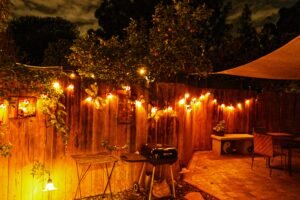
- String lights are a classic choice, but placement matters. Instead of zigzagging them across the entire ceiling (which can feel cluttered), run them in clean lines along one or two railings. Or create a “ceiling” effect by draping them overhead in a single, taut line from one corner to the opposite wall.
- Floor lanterns placed at ground level add soft, upward light. In a small space, tuck one into a corner behind a plant. The light reflects off the wall and plant leaves, creating depth.
Accent Lighting for Character
Accent lighting highlights specific features—a beautiful pot, a textured wall, a hanging plant.
- Small uplights (often called “well lights”) placed at the base of a tall plant create dramatic shadows on the wall behind it.
- Puck lights under a railing cap or mounted on a wall highlight architectural details.
The key in a small space: keep accent lights subtle. One or two well-placed accents add sophistication; five or six create visual chaos.
Step 4: Define Boundaries with Perimeter Lighting
Small spaces feel cramped when you can’t see the edges. But when you illuminate the perimeter, you visually expand the area.
The best outdoor lighting placement for small apartments includes perimeter lighting along:
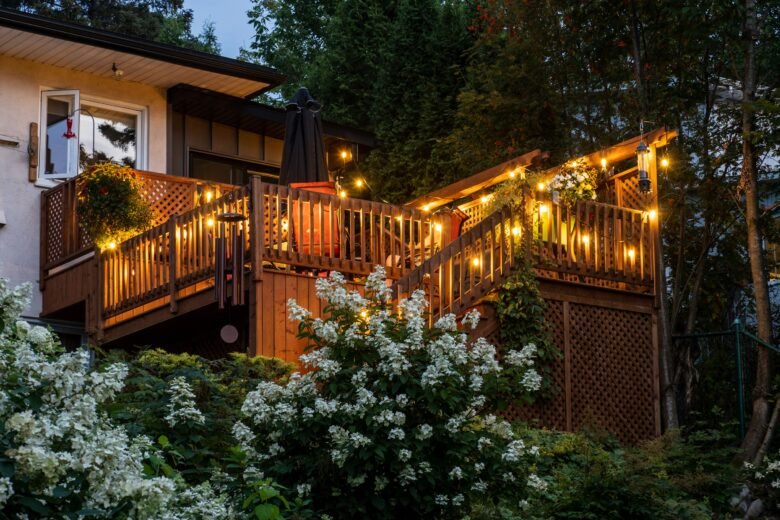
- Railings: Wrap string lights around the railing itself, or use rail-mounted solar caps. This defines the boundary without taking up floor space.
- Floor edges: Place low-profile LED strips along the base of walls or the balcony floor’s perimeter. These guide the eye outward.
- Planters: Line the outer edge of a planter box with small fairy lights. This creates a soft glow that marks the space’s boundary while adding greenery.
Step 5: Master Spacing in Tight Quarters
In a standard backyard, you might space lights 8 to 10 feet apart. In a small apartment balcony (say, 6×10 feet), that same spacing leaves huge dark gaps.
For small spaces:
- Place lights every 3 to 5 feet along railings or walls.
- Cluster lights in seating areas rather than spreading them evenly. A cluster of three small lanterns on a side table creates more impact than one central overhead light.
- Various heights. Mix lights at floor level, table height, and overhead. This prevents the “operating room” effect, where everything is lit from one angle.
Common Mistakes to Avoid
Even with the best intentions, apartment dwellers often make these five mistakes. Avoiding them will save you frustration—and your security deposit.
Mistake 1: Overlighting a Tiny Space
Why it happens: You want your space to feel bright and welcoming, so you add more lights than necessary.
The fix: Stick to three light sources per 50 square feet. In a 40-square-foot balcony, that means two to three lights total, plus maybe string lights as an accent. More than that, and it feels like a parking lot.
Mistake 2: Placing Lights at Eye Level
Why it happens: It’s natural to hang lights where they’re easy to install, like at eye level on a wall or railing.
The fix: Light at eye level creates glare and makes the space feel smaller. Move lights either above eye level (overhead) or below (knee height or floor level). Your eyes should never look directly into a bare bulb.
Mistake 3: Ignoring Your Neighbors
Why it happens: You’re focused on your own space and forget that your balcony is inches away from someone else’s bedroom.
The fix: Use shielded or downward-facing fixtures. Avoid floodlights that throw light horizontally. Solar lights with adjustable panels let you direct light where you need it—and away from neighbors’ windows.
Mistake 4: Using Only Solar Lights
Why it happens: Solar lights are easy, cordless, and seem perfect for rentals.
The fix: Solar lights are great for accents but unreliable for task or safety lighting. They dim over the evening and fail on cloudy days. Use them for ambiance only. For your entry and seating area, invest in battery-powered or USB-rechargeable lights with consistent output.
Mistake 5: Forgetting About Weatherproofing
Why it happens: You buy cute indoor fairy lights and hang them outside, thinking they’ll be fine under the awning.
The fix: Even covered balconies get moisture, wind, and temperature swings. Check IP ratings: IP44 is splash-proof; IP65 or higher handles direct rain. If your lease prohibits permanent fixtures, look for “weather-resistant” or “outdoor-rated” on all lights and cords.
Pro Tips / Expert Insights
Here’s what professional lighting designers know that most apartment dwellers don’t:
- Use mirrors strategically. A small, outdoor-safe mirror placed opposite your light source can double the perceived brightness without adding another fixture. It’s a trick often used in tiny homes and small patios.
- Think vertical. When floor space is tight, light vertically. Hang a pendant light from a ceiling hook (using a battery-powered version) or attach adhesive LED strips to the underside of an umbrella or overhang.
- Layer with plants. Position a light behind a large-leaf plant. The light filters through the leaves, casting beautiful shadows and softening the overall effect. This is especially effective on small balconies where you can’t have many light sources.
- Use smart bulbs. A single smart bulb in a portable lantern gives you color temperature control. Switch from cool white (5000K) for working to warm amber (2200K) for evening relaxation, all without buying multiple fixtures.
String Lights vs. Portable Lanterns
| Feature | String Lights | Portable Lanterns |
|---|---|---|
| Best for | Defining perimeter, overhead ambiance | Task lighting, flexible placement |
| Space efficiency | Excellent—uses vertical/railing space | Moderate—takes up floor or table space |
| Installation | Requires hooks or railing attachment | None—place anywhere |
| Light direction | Diffuse, omnidirectional | Directional or diffused (depending on shade) |
| Weather resistance | Varies widely; check IP ratings | Generally higher; designed for outdoor use |
| Lease compliance | Usually allowed with removable hooks | Always allowed |
| Cost per lumen | Low initial cost; may need replacement | Higher upfront; longer lifespan |
Our recommendation: Use string lights for perimeter definition and ambient glow. Then add two portable lanterns—one for your table and one for floor-level accent. This combo gives you flexibility and full coverage without permanent installation.
Real-Life Scenario: How Sarah Lit Her 5×7 Balcony?
Sarah lives in a third-floor walk-up in Chicago. Her balcony is 5 feet by 7 feet—barely enough room for a small table and two chairs. Her main complaints: she couldn’t see her plants at night, and the single overhead light (a bare bulb left by the previous tenant) glared into her neighbor’s window.
Her solution:
- Entry safety: She added a magnetic motion-sensor light to the door frame. Cost: $18.
- Perimeter: Instead of string lights overhead, she wrapped a 15-foot strand of warm-white fairy lights around the railing. This defined the boundary and didn’t block her neighbor’s view.
- Seating area: She bought two rechargeable lanterns. One sits on the table for dining; the other tucks into a corner behind a tall snake plant.
- Accent: A small gooseneck clip light attaches to the railing, aimed at her herb garden.
The result: Sarah now uses her balcony nightly. Her neighbor complimented the lighting—no glare, just a soft glow. Total cost: under $80. Installation time: 20 minutes. No tools required.
Summary
You don’t need a sprawling backyard or a professional electrician to create an outdoor space you love. The best outdoor lighting placement for small apartments comes down to three things: safety at the entry, layered lighting around your seating, and perimeter definition that makes the space feel larger.
Start with one zone at a time. Place that motion light by the door first—it’s the easiest win. Then add perimeter lighting along your railings. Finally, layer in portable lanterns and accent lights where you actually sit and relax.
FAQs
How many lights do I need for a small balcony?
For most small balconies (under 60 square feet), aim for three to five light sources. This typically includes one safety light near the door, two ambient sources (like string lights or lanterns), and one task light for seating or plant care.
Can I install outdoor lighting without drilling?
Absolutely. Use magnetic mounts for metal railings and doors, adhesive hooks for string lights, and clamp-style fixtures for railings. Battery-powered and solar lights require no wiring or permanent attachment.
What’s the best outdoor lighting placement for a small apartment to avoid bothering neighbors?
Focus on downward-facing lights and shielded fixtures. Place lights at or below railing height to prevent light from spilling into neighboring units. Use warm color temperatures (2700K or lower), which are less intrusive than cool white or blue-toned lights.
Are solar lights effective on covered balconies?
Partially. Solar lights need direct sunlight to charge. On covered balconies or north-facing units, they may not receive enough light to last through the evening. Use solar for accent only, and rely on USB-rechargeable or battery-powered lights for consistent illumination.
What color temperature is best for apartment outdoor lighting?
Warm white (2700K–3000K) is ideal. It mimics candlelight and creates a cozy, inviting atmosphere. Cool white (4000K+) feels harsh in small spaces and can appear clinical.
How do I weatherproof my lighting on a rental balcony?
Choose lights with an IP44 rating or higher. Use outdoor-rated extension cords if needed, and always unplug fixtures during heavy rain or snow. For string lights, make sure the connection points are covered with weatherproof caps or tucked under a covered area.