
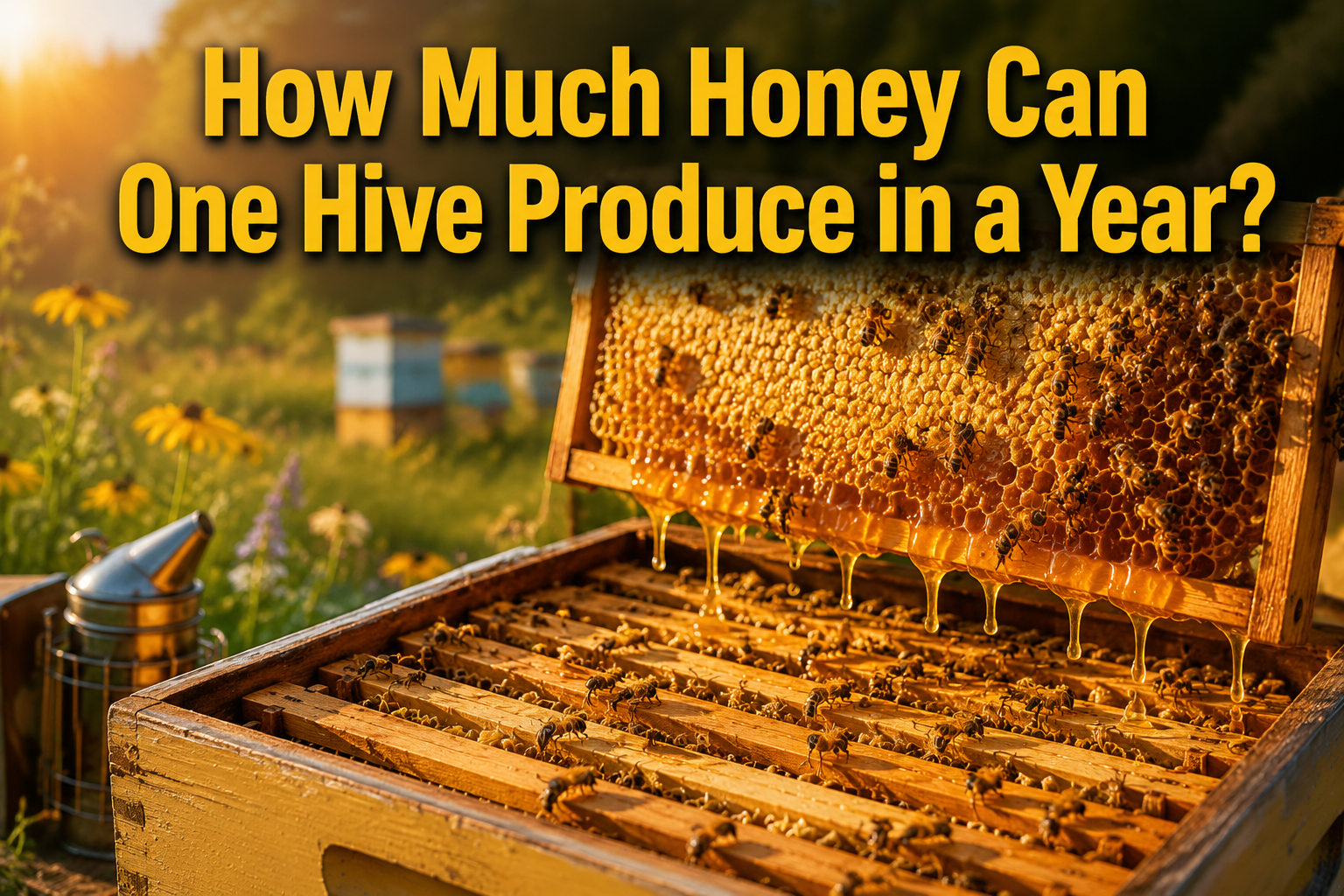
A single healthy beehive can produce between 30 to 100 pounds of honey per year, with most hives averaging 60 pounds under good conditions. The amount of honey a hive produces depends on factors like colony strength, local flower availability, weather patterns, and hive management practices.
What Determines How Much Honey Can One Hive Produce?
The honey that one hive can produce varies dramatically based on colony health and environmental conditions. A strong hive with 40,000-60,000 bees during peak season collects far more nectar than a weak colony of 20,000 bees.
Key production factors include:
- Colony population size: More forager bees mean more nectar collection.
- Queen quality: Productive queens maintain larger, healthier colonies.
- Local nectar sources: Diverse flowers within 2-3 miles of the hive.
- Weather patterns: Consistent mild temperatures and adequate rainfall.
- Hive management: Disease prevention, proper spacing, and feeding when needed.
- Seasonal timing: Strong colonies ready for major nectar flows.
Common mistake: New beekeepers often expect high honey yields in the first year. First-year colonies focus on building comb and population, not honey surplus.
How Much Honey Production Changes by Season?
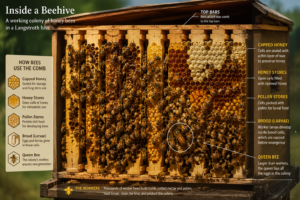
Honey canes one hive produces fluctuates dramatically throughout the year, with most production concentrated in the spring and summer months. Bees produce honey only when nectar sources are abundant, and weather permits foraging.
Seasonal honey production breakdown:
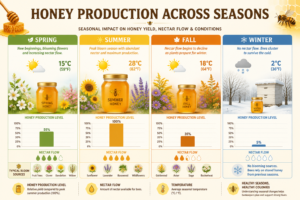
- Spring (March-May): 40-50% of annual production during fruit tree blooms.
- Summer (June-August): 30-40% from wildflowers, clover, and garden plants.
- Fall (September-November): 10-20% from late-blooming flowers like asters.
- Winter (December-February): 0% production, bees consume stored honey.
Peak production periods:
- Main nectar flow: 2-4 week periods when bees can collect 2-5 pounds daily.
- Minor flows: Shorter periods yielding 0.5-1 pound per day.
- Dearth periods: Times with no nectar when bees may consume stores.
Choose supplemental feeding if your area has extended dearth periods lasting more than 3-4 weeks, especially in late summer.
What’s the Difference Between Total Honey and Harvestable Surplus?
Bees produce more honey than beekeepers can harvest because colonies need 40-60 pounds to survive winter. The honey that one hive can produce for harvest represents only the surplus beyond survival needs.
Honey allocation in a typical hive:
- Winter stores: 40-60 pounds reserved for colony survival.
- Brood rearing: 10-20 pounds consumed during active season.
- Daily operations: 5-10 pounds for immediate colony needs.
- Harvestable surplus: 20-40 pounds available for beekeepers.
Harvest timing rules:
- Leave 60+ pounds in northern climates with long winters.
- Leave 40+ pounds in southern regions with mild winters.
- Never harvest from first-year colonies still building strength.
- Stop harvesting 6-8 weeks before the expected first frost.
Edge case: During exceptional years with multiple strong nectar flows, experienced beekeepers may harvest 60-80 pounds while still leaving adequate winter stores.
How Does Hive Location Affect Honey Production?
The honey that one hive can produce depends heavily on local flower diversity and density within the bees’ 2-3 mile foraging radius. Rural areas with mixed agriculture and wildflowers typically outproduce urban or monoculture locations.
High-production locations:
- Mixed farmland with clover, alfalfa, and diverse crops.
- Areas near fruit orchards or berry farms.
- Regions with abundant wildflower meadows.
- Locations with multiple overlapping bloom periods.
Lower-production areas:
- Dense urban environments with limited green space.
- Monoculture farmland (corn, soybeans only).
- Desert regions with sparse, seasonal blooms.
- Areas with heavy pesticide use.
Choose your apiary site based on flower diversity rather than convenience. A location with 20+ different plant species blooming throughout the season will consistently outproduce areas with only 5-10 species.
Common mistake: Placing hives too close to neighbors who use systemic pesticides, which can reduce forager populations and honey yields.
What Factors Reduce Honey Production in a Hive?
Several controllable and uncontrollable factors can significantly limit how much honey can one hive can produce during a season. Understanding these helps beekeepers set realistic expectations and take preventive action.
Weather-related reductions:
- Drought conditions: Flowers produce less nectar, reducing daily collection by 50-80%.
- Excessive rainfall: Prevents foraging flights and dilutes available nectar.
- Temperature extremes: Bees can’t forage effectively below 55°F or above 95°F.
- High winds: Limit flight activity and reduce foraging efficiency.
Colony health issues:
- Varroa mites: Weaken bees and reduce forager populations by 20-40%.
- Nosema disease: Causes dysentery and reduces bee lifespan significantly.
- Queen problems: Poor laying patterns result in smaller populations.
- Swarming: Colony splits reduce workforce during peak production periods.
Management factors:
- Late spring feeding: Can delay natural foraging behavior.
- Overcrowded conditions: Triggers swarming instincts.
- Poor hive placement: Locations with afternoon shade reduce activity.
Troubleshooting tip: If production drops suddenly, check for mite levels first, then assess queen performance and local nectar availability.
How Do First-Year vs. Established Hives Compare?
New colonies and established hives show dramatic differences in how much honey one hive can produce annually. First-year hives prioritize growth over honey storage, while mature colonies can dedicate more energy to surplus production.
First-year hive production (0-30 pounds):
- Focus on building a comb and establishing a population.
- May require feeding through the first winter.
- Rarely produce harvestable surplus in northern climates.
- Can yield 10-30 pounds in areas with long growing seasons.
Second-year hive production (20-60 pounds):
- An established comb allows faster population growth.
- Ready for early nectar flows with adequate bee numbers.
- Typically produce first significant honey surplus.
- May still need supplemental feeding in poor years.
Mature hive production (40-100+ pounds):
- Full-sized colonies with 8-10 frames of bees at peak.
- Efficient foraging teams are ready for all nectar flows.
- Consistent surplus production in average years.
- Can be split to create new colonies while maintaining production.
Decision rule: Don’t expect honey harvest from first-year packages or nucleus colonies. Plan for surplus starting in year two under normal conditions.
What Management Practices Increase Honey Yields?
Proper hive management can increase how much honey can one hive can produce by 20-50% compared to neglected colonies. Simple practices like timing, feeding, and disease prevention make significant differences in annual yields.
Essential management practices:
Spring preparation:
- Early feeding: Stimulate brood rearing 4-6 weeks before the main nectar flow.
- Add supers early: Provide storage space before bees feel crowded.
- Monitor queen performance: Replace poor layers before peak season.
- Control mite levels: Treat if counts exceed 2-3 mites per 100 bees.
During production season:
- Stay ahead of space needs: Add supers when existing ones are 70% full.
- Minimize inspections: Limit disruptions during heavy nectar flows.
- Ensure adequate ventilation: Prevent overheating during hot weather.
- Monitor for swarming signs: Remove queen cells promptly if not desired.
Harvest timing:
- Wait for proper moisture: Only harvest capped honey (18-19% moisture).
- Leave adequate stores: Reserve 1.5-2 deep frames per expected winter month.
- Extract promptly: Process honey within days of removal to maintain quality.
Pro tip: Keep detailed records of production, weather, and management actions to identify patterns and improve future yields.
Summary
The honey that one hive can produce ranges from 30-100 pounds annually, with most healthy colonies averaging 60 pounds under good management and favorable conditions. Success depends on maintaining strong populations, ensuring adequate local nectar sources, and timing management practices around natural flower cycles.
FAQ
How much honey does a bee make in its lifetime?
A single worker bee produces about 1/12 teaspoon of honey during her entire 6-week summer lifespan. It takes roughly 556 worker bees to produce one pound of honey.
Can you harvest honey from a hive in its first year?
Generally, no, especially in northern climates. First-year colonies need all their honey stores to survive winter and establish strong populations for the following year.
What’s the most honey ever harvested from one hive?
Record yields can exceed 200-300 pounds in exceptional years with perfect conditions, though 60-80 pounds represents excellent production for most beekeepers.
How do you know when honey is ready to harvest?
Harvest only when at least 80% of cells are capped with wax, indicating moisture content below 18.5%. Uncapped honey may ferment during storage.
Does taking honey hurt the bees?
No, when done properly. Beekeepers only harvest surplus honey beyond what colonies need for survival, leaving 40-60 pounds for winter stores.
How much space do bees need to store 60 pounds of honey?
Approximately 4-5 deep frames or 8-10 medium frames can hold 60 pounds of honey when fully capped and stored efficiently.
What time of year do bees make the most honey?
Late spring through mid-summer, typically May through July in most temperate regions, coincides with peak flower blooms and optimal weather.
Can urban hives produce as much honey as rural ones?
Urban hives often produce less due to limited flower diversity, though well-planned city gardens and parks can support decent honey yields of 30-50 pounds annually.
How does the weather affect daily honey production?
Ideal conditions (70-85°F, light winds, recent rain followed by sunny days) allow colonies to collect 3-5 pounds daily during peak flows.
What happens if you don’t harvest honey?
Bees will continue storing honey until all available space is filled, potentially leading to overcrowding and increased swarming behavior the following spring.
How long does it take bees to fill a honey super?
During strong nectar flows, a healthy colony can fill a medium super (30-40 pounds capacity) in 1-2 weeks under ideal conditions.
Do all flowers produce the same amount of nectar?
No, nectar production varies dramatically. Basswood and tulip poplar are excellent producers, while some ornamental flowers provide little to no nectar for bees.