There’s a moment every evening most homeowners miss, that window between sundown and bedtime when your outdoor space could look incredible, but instead sits in the dark.
If your patio lights still rely on manual switches, timers you reprogram twice a year, or an extension cord under the back door, it’s time for a serious upgrade.
Automatic solar lighting has quietly matured into a category that genuinely delivers, and this year might be the tipping point when switching stops being a nice idea and starts being the obvious one.
Solar Lighting Has Changed
Most people picture solar lights as faded plastic stakes that glow amber for about 40 minutes before quietly giving up. That product still exists, mostly in big-box stores at impulse-buy prices, and it’s responsible for a lot of undeserved scepticism toward the whole category.
According to a recent industry report from Global Market Insights, the outdoor solar LED market has seen a split between budget and premium products in recent years, with budget options becoming more affordable and maintaining low prices.
But premium solar lighting quietly crossed a threshold where it’s now genuinely competitive with hardwired alternatives, not just as a workaround, but as a first choice.
Today’s best outdoor solar lights are built from solid brass and powder-coated aluminium, feature replaceable batteries, and are engineered to survive everything from summer thunderstorms to winter freeze-thaw cycles without issue.
Some owners report running the same lights for three or more years through multiple seasons and climates with zero maintenance. According to Consumer Reports, the durability now seen in solar outdoor lights was not available even a few years ago, and a major advancement has been the significant increase in brightness.
Modern solar security lights in the $12–$37 price range now produce anywhere from 140 lumens on the low end to over 1,300 lumens from a single fixture, more than enough to flood a patio, illuminate a pathway, or light up a feature wall.
The difference between a $3 stake light and a quality solar flood is solar panel efficiency, battery capacity, and LED quality.
When you buy in that upper range, you get monocrystalline or high-efficiency panels, proper lithium cells, and LEDs that maintain consistent output for hours instead of fading after the first hour of darkness.
The “Automatic” Part Is the Real Upgrade
The feature that transforms a solar light from novelty to essential is full automation. A quality automatic solar light does three things: it charges during the day, switches on at dusk, and adjusts or switches off at dawn.
No app required, no schedule to configure, no override to remember when you leave for the weekend. This dusk-to-dawn automation is now standard on most mid-range and premium solar fixtures.
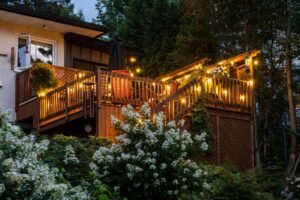
According to Tom’s Guide, solar-powered string lights like the AMIR model are easy to set up and create a cosy atmosphere on your patio, making them a convenient way to light your outdoor space at night automatically. You stop thinking about the lights. They’re just on when you need them and off when you don’t. Guests notice the ambience; you don’t notice the work.
Many fixtures offer a dual-mode design: a low-level ambient glow runs continuously from dusk to dawn, and when motion is detected, the light jumps to full brightness. For a patio, this means soft, welcoming light as a baseline, with an automatic boost whenever someone steps outside.
According to Consumer Reports, this kind of layered behavior, often associated with professionally installed smart lighting, is now available in self-contained solar lighting units that do not require an electrician or wiring.
Consumer Reports confirms that some solar outdoor lights offer features such as motion detection, though specific performance details are not provided.
Motion Detection: What the Testing Actually Shows?
Motion sensing is where there is the most variation between products, and where doing some research before buying pays off.
In head-to-head tests across more than a dozen solar security lights, detection range varied from as little as 7 feet to over 21 feet. That is not a small difference. A light that only triggers at 7 feet gives you almost no warning and minimal security value. The best performers reliably detected movement at 15 to 21 feet, with wide lateral coverage up to 170 degrees.
For patio use, you want a motion sensor with at least 15 feet of range and a wide enough detection angle to cover the full seating area without requiring someone to walk directly in front of the fixture. A 120-degree to 180-degree arc is the sweet spot.
According to Lumen Wholesale, important features like brightness, battery capacity, motion detection range, and build quality are key indicators of better motion performance in outdoor solar sensor lights, so looking for products with solid build quality can be a helpful shortcut if you are unable to test them in person.
According to Consumer Reports, leading solar outdoor lights now offer advanced features such as RGB colour-changing options and dedicated white LEDs, allowing users to enjoy both vibrant colour modes and warm white lighting for everyday use.
More sophisticated versions of these lights support grouping and controlling multiple fixtures as a single coordinated system via a smartphone app. According to T3.com, Govee’s new Outdoor Chromatic String Lights stand out by allowing users to control each bulb individually, creating impressive visual effects along patios or pathways, especially when lighting the way to an entrance.
For patios, this kind of coordinated colour control opens up seasonal and event-based lighting that would normally require professional installation.
Setting the whole perimeter to warm amber for a dinner party, or cycling through greens and reds during the holiday season, becomes a 30-second task in an app rather than a hardware project.
A practical limitation is that battery-intensive colour modes consume more power than basic white, so the runtime for full RGBW animation is shorter than for dusk-to-dawn white. Most smart solar fixtures compensate with an eco mode that reduces brightness to extend runtime.
According to Halo Outdoor Lighting, a fully charged solar flood light can typically last 8 to 12 hours on a single charge, depending on battery capacity and brightness settings.
If you go this route, pay close attention to the app quality. The software is the actual product in a smart lighting ecosystem, and there’s a wide range from polished and responsive to slow and frustrating.
An app with an interactive product image, well-labelled preset scenes, and smooth group controls is a sign that the company invested seriously in the platform rather than bolting on an afterthought.
How to Choose the Right Solar Light for Your Patio?
The right fixture depends on what you are trying to accomplish.
Here is how to think through it:
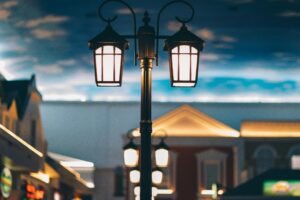
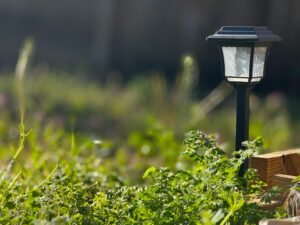
For ambient pathway or perimeter lighting, look for stake-mounted or post-style lights with dusk-to-dawn automation. Prioritise brass or aluminium construction over plastic, and ensure the battery is replaceable. A 60-lumen output per fixture is plenty for walkways when multiple units are evenly spaced.
According to Consumer Reports, you should budget about $35 to $50 per solar outdoor light if you want a model built to last through multiple seasons. For security or motion-activated lights, focus on options with a strong detection range and high peak brightness.
According to product information from Walmart, the Hyper Tough 800 Lumen Path and Area light comes as a two-pack and is designed to illuminate outdoor spaces with no electrical outlet access, making it a valuable option for patio entrances where bright, motion-activated lighting is needed. R side gates.
For decorative smart lighting, invest in an RGBW system with a good app and group support. The per-unit cost is higher, but the ability to coordinate color and animation across multiple fixtures multiplies the visual impact.
Plan for eight or more fixtures if you are lighting a full patio perimeter or a long pathway. The group effect is what makes these compelling.
For covered patios or spaces with limited direct sun, look for split-design lights with remote solar panels. Several quality fixtures include a cable, typically 9 to 16 feet, that lets you mount the light under cover while positioning the panel in direct sun a few feet away.
This design solves the biggest obstacle to solar in shaded outdoor spaces.
The Real Cost Comparison
Automatic solar lights have no ongoing electricity cost and require no trenching, conduit, or electrician fees. A full patio perimeter of eight quality solar fixtures at $40 each runs $320, about what a licensed electrician charges for two or three hours of low-voltage landscape wiring work before any material costs.
The long-term replacement math also favors solar. When a solar light’s battery eventually degrades, typically after 500 or more charge cycles or two to three years of daily use, many quality manufacturers now offer replaceable battery packs, bringing the fixture back to full performance without replacing the whole unit.
That is a meaningful departure from the disposable-product model that defined cheap solar lighting for years.
Running cost over five years for eight hardwired 10-watt patio lights running six hours per night comes to roughly $87 in electricity at average US rates, not enormous, but it’s a real number.
According to Consumer Reports, solar-powered LED lights let you safely enjoy your backyard well into the late evening.
What to Expect in the First Week?
The most common disappointment with solar lights is expecting full performance immediately after unboxing. Most quality fixtures require 2 to 3 full charge cycles before the battery reaches its rated capacity. If your lights seem dimmer or shorter-lived than expected in the first few days, give them a week of sun before making a final decision.
According to Tom’s Guide, where you place solar lights is crucial to performance: lights that receive more direct sunlight will perform better than those in shaded or partially sunny areas. Before installing, check your patio’s sun exposure at different times of day, and consider using solar lights with remote panels if your preferred spot doesn’t get enough sunlight. ade.
Finally, keep the solar panels clean. Dust, pollen, and bird debris accumulate over weeks and reduce charging efficiency. A quick wipe with a damp cloth every few weeks takes thirty seconds and can make a noticeable difference in how long your lights run at night.