
I have stared at my fair share of blinking cursors on blank documents, wondering how to summarize my entire professional existence into 300 words without sounding like a desperate robot.
Most job seekers view the cover letter as a polite formality, a digital thank-you note required to submit an application. They fill the page with generic phrases like “I am writing to express my interest,” effectively making the hiring manager do all the heavy lifting to figure out if the candidate actually brings value.
When you write a cover letter this way, you signal that you are a high-maintenance hire who needs training, rather than a professional who can solve immediate problems. The reality is harsh but simple: hiring managers care about how much risk you bring versus how much return on investment you can deliver.
If you want your cover letter to be read and, more importantly, acted upon, you need to stop writing an application and start writing a business pitch.
The ATS Reality Check: Passing the Machine First
Before a human ever sees your carefully crafted prose, it must survive the Applicant Tracking System (ATS). Most cover letters fail because candidates believe the software judges creativity. It doesn’t. It judges structure, relevance, and keyword alignment.
An ATS parses text line by line, extracting keywords related to your skills and matching them against the job description. When you introduce complex formatting, you break the parser.
The Trade-Off: Design vs. Deliverability
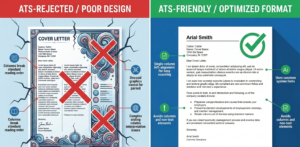
Many candidates use visually striking templates with sidebars, custom graphics, and unique fonts, hoping to stand out. The downside? The ATS often scrambles this data into unreadable code.
To ensure your letter makes it to a human desk, adhere to strict formatting rules:
- Typography: Stick to universal fonts like Arial, Calibri, or Times New Roman, sized between 10.5 and 12.
- Layout: Use standard left alignment, single or 1.15 spacing, and absolutely no tables, text boxes, or columns.
- File Format: Unless the job posting specifically asks for a PDF, a standard .docx file is the safest bet for ATS parsing.
Writing a “Pain Letter” (Thinking Like a Consultant)

Once you pass the machine, you must hook the human.
A standard cover letter summarizes the past; a highly effective cover letter—often called a “Pain Letter”—focuses squarely on the employer’s future.
A Pain Letter identifies the hiring manager’s biggest operational problem and proves that you have the specific experience to solve it. According to Liz Ryan, who popularized the concept in Forbes, candidates who utilize this strategy see callback rates of roughly 25%.
How to Find the Pain Point?
You don’t need insider corporate espionage to find an organization’s pain points. The clues are usually public:
- Read the Job Description critically: If the ad states, “Seeking a recruiter to double our engineering team in two months,” the pain is on an aggressive scale and potential burnout.
- Analyze Public Signals: Look at recent quarterly earnings, press releases, or the CEO’s LinkedIn posts. If they just launched a new product line, their pain point is likely market penetration or user onboarding.
- Read Customer Reviews: Check Glassdoor or G2. If users constantly complain that “support takes three days to reply,” your pitch should revolve around how you cut ticket resolution times by 40% in your last role.
Nailing the Salutation Without a Name
One of the most agonizing parts of writing a cover letter is the greeting. Addressing an anonymous void feels unnatural. However, the first line of your document tells the reader immediately if you are detail-oriented or just spamming the “Apply” button.
The Detective Work
Give yourself exactly 20 minutes of focused research to find the hiring manager’s name.
- LinkedIn filtering: Search the job title, add the company name, and filter by “Posts.” Often, the hiring manager will have posted, “I’m hiring for my team!”
- The direct approach: A polite phone call to the company reception desk asking, “May I confirm who leads the hiring process for the Senior Analyst role so I can address them properly?” shows incredible initiative.
Fallback Greetings That Actually Work
If your detective work fails, do not default to outdated relics. Time magazine warns that “To Whom It May Concern” signals sheer laziness. Furthermore, “Dear Sir/Madam” is increasingly viewed as exclusionary; in fact, UK government bodies like the Hackney Council banned the phrase entirely in 2024 to foster inclusivity.
Use these instead:
- The Universal Safe Choice: “Dear Hiring Manager” is gender-neutral, universally understood, and accepted everywhere from startups to Fortune 500s.
- The Department Target: “Dear Product Team” or “Dear Marketing Department.” This works exceptionally well for early-stage startups that hire collaboratively.
- The Committee Approach: If applying to academia or government, “Dear Search Committee” or “Dear Hiring Panel” mirrors their internal bureaucratic language and respects their collaborative process.
The 4-Paragraph Framework That Wins Interviews
A cover letter is not an autobiography. Busy managers spend about 30 seconds skimming these documents. You have approximately 300 words to make your case.
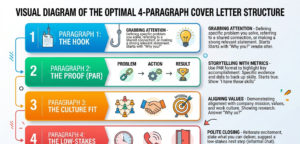
Paragraph 1: The Hook (Cut the Fluff)
Never open with, “I am writing to apply for the position of…” They know why you are writing; you are in their application inbox.
Instead, start strong. If you have a referral, name-drop immediately in the first sentence. Referrals make up roughly 45% of internal hires, so mentioning a trusted internal employee significantly lowers your perceived risk.
If you don’t have a referral, lead with a tailored hook that connects your past success to their current pain point.
Example Hook: “When I rebuilt the onboarding flow at Acme Corp and reduced customer churn by 22%, I immediately thought of how I could bring these data-driven retention strategies to [Company Name]’s rapid expansion into enterprise accounts.”
Paragraph 2: The Proof (Using the PAR Method)
Here is where you provide evidence. Do not copy and paste your resume bullets. Instead, use the PAR method (Problem, Action, Result) to contextualize your skills.
To sound authoritative, rely on powerful action verbs. Instead of saying “I was responsible for,” use words like Spearheaded, Orchestrated, Synthesized, Re-engineered, or Quantified.
Example Proof: “I noticed [Company Name] is currently scaling its customer success operations. In my previous role, many teams struggled with this exact growth phase. By restructuring our CRM tagging system and deploying automated check-ins, I cut ticket response time by 30% and saved the department $40,000 annually.”
Paragraph 3: The Company Connection
This is the paragraph where 90% of applicants fail. They offer generic praise like, “I admire your innovative culture.” You must be specific to prove you aren’t just sending a template.
Mention a recent funding round, a specific product feature you admire, or a technical hurdle they are facing.
Example Connection: “Your CEO’s recent keynote on making ethical credit accessible aligned perfectly with my motivation for entering the fintech space, and I am eager to help navigate the FCA compliance requirements necessary for your Q3 product launch.”
Paragraph 4: The Call to Action (The Low-Stakes Close)
Standard cover letters end with, “I hope to hear from you.” This sounds desperate and puts the burden of momentum entirely on the hiring manager.
Instead, close by proposing a low-friction business discussion.
Example Close: “I have mapped out a brief 30-day strategy on how I would handle the upcoming compliance audit, and I’d be happy to share it. Can we connect for a brief 15-minute chat next Tuesday?”
This subtle shift in tone changes the dynamic from a terrifying “job interview” to a collaborative “business chat”.
Real-World Case Study
Let’s look at how the shift from a generic summary to an experience-driven pitch changes the perception of an applicant.
Comparison Table: Generic vs. Expert Pitch
| Element | Generic Approach | The Expert Pitch (Pain Letter) | Why It Works Better |
|---|---|---|---|
| Opening | “I am writing to express my interest in the Product Manager role.” | “Your Q3 earnings call mentioned slowing customer retention. I have a proven framework to fix this.” | Grabs attention instantly. Demonstrates deep research and immediate business value. |
| Body Focus | “At my last job, I was responsible for managing the product roadmap and leading stand-ups.” | “By re-engineering the user onboarding flow, I reduced Day-1 churn by 18%, recovering $120k in ARR.” | Uses strong action verbs and exact metrics to quantify success rather than just listing duties. |
| Closing | “Thank you for your time. I look forward to an interview.” | “I’d love to share the retention framework I built. Do you have 15 minutes next week to chat?” | Re-frames the interaction as a professional consultation rather than a plea for a job. |
The 5-Minute Tailoring System
You cannot spend three hours writing a custom manifesto for every job application. Job hunting is a volume game, but sending generic spam is a losing strategy.
Here is a 5-minute, practical implementation step-by-step to scale your efforts without sacrificing quality:
- Extract the Keywords (60 seconds): Scan the job description for the exact job title and 3-4 core technical skills (e.g., “SEO, Content Creation, Analytics”).
- Slot the Evidence (120 seconds): Take your master cover letter template and swap out the metrics in paragraph two to directly address the extracted keywords.
- The Custom Connection (60 seconds): Find one recent news article or blog post from the company and drop it into paragraph three.
- Format and Proofread (60 seconds): Ensure the company name is spelled correctly, double-check your contact info, and export the file as Firstname_Lastname_JobTitle_CoverLetter.docx for ATS readability.
Common Mistakes Checklist
Before you hit submit, ensure you haven’t fallen into these trapdoors:
- Repeating the resume: Does the letter tell a new story, or is it just a prose version of your CV?
- Using weak verbs: Did you replace “Helped with” and “Worked on” with words like Pioneered, Diagnosed, or Accelerated?
- Cultural mismatch: Are you using UK spelling (organisation) for a US company (organization)? Match the localized spelling from the job description.
- Assuming titles: If you don’t know the hiring manager’s gender, did you drop the honorifics (Mr./Ms.) entirely? Misgendering a stranger can immediately end your candidacy.
Frequently Asked Questions
Do cover letters still matter in 2026?
While some candidates skip them, data shows that 83% of hiring managers still read cover letters when they are provided. Sending a sharp, targeted pitch easily separates you from the nearly 45% of applicants who skip the step entirely.
What if I don’t have enough experience?
If you are entry-level, the cover letter shouldn’t focus heavily on the past—that is the resume’s job. Focus on the future. Emphasize adaptability, how quickly you learn, and connect relevant academic or internship projects directly to the company’s goals.
How do I handle third-party recruiters?
If a staffing agency or third-party recruiter posted the role, address the letter directly to the recruiter by name. They are the ones pre-screening you. If the end-client is hidden, acknowledge it professionally: “I appreciate that the end employer remains confidential at this stage.”
Final Thoughts
A cover letter is a canvas, not an obstacle. It is the only spot in the strict job application process where you can include complexity, context, and a thorough understanding of the business environment.
When you stop seeing the cover letter as a monotonous description of your job history and instead treat it as a targeted solution to solve a company’s pain issues, you change your stance. You are no longer just another applicant looking for a shot. You become an expert, providing a valuable solution. This is how you get read and employed.